
Pigeons
Brown Rat

Black Rat
Bed Bugs
Bees
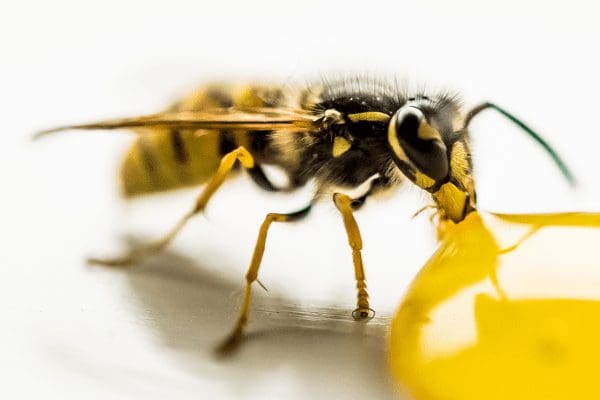
Wasps
Mice

Fruit Flies
Cluster Flies
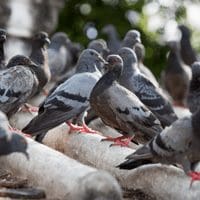
PIGEONS (COLUMBA LIVIA)
CONTROL
There are several methods available for controlling feral pigeon populations and preventing problem flocks from settling, including wiring, netting, pointing and pesticides.
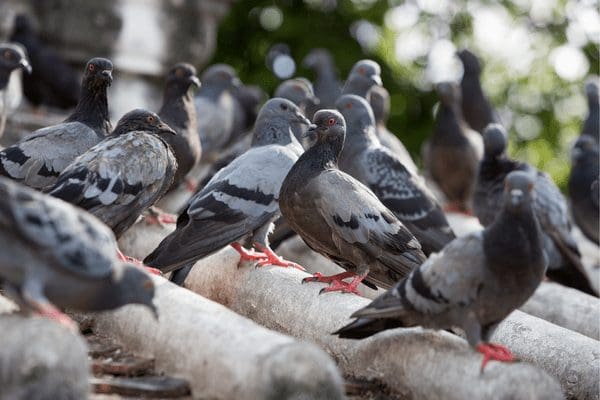
The feral pigeon is well adapted to life in an urban environment. The dependence of the feral pigeon on man for food has led to it becoming a serious pest. The bird is about 33cm long and weighs on average 330g. There is a wide variation in the colour of the plumage. This species has no readily distinguished distress call.
Both old and modern buildings contain large numbers of ledges, girders and gaps which can be used by feral pigeons as nesting sites. Large numbers of nests are often found inside lofts of houses and commercial premises.
If conditions are favourable the birds will breed throughout the year, but the main breeding period is from March to July. White eggs are laid and are incubated by both sexes for 17-19 days. Young birds are independent at 30-37 days and 4-7 broods may be reared in a year.
Many pigeons in town centres are regularly fed by members of the public. They feed in flocks and tend to rely on food scraps and spillage in town centres and at food premises.
Each flock of feral pigeons occupies a distinct territory which includes feeding, roosting and perching sites and nesting areas. The flock is in balance with the availability of food and breeding sites within the territory.
Within a flock there is a distinct order. The dominant birds feed first. Lower ranking birds are under more pressure to find food and harbourage.
THE BROWN RAT (RATTUS NORVEGICUS)
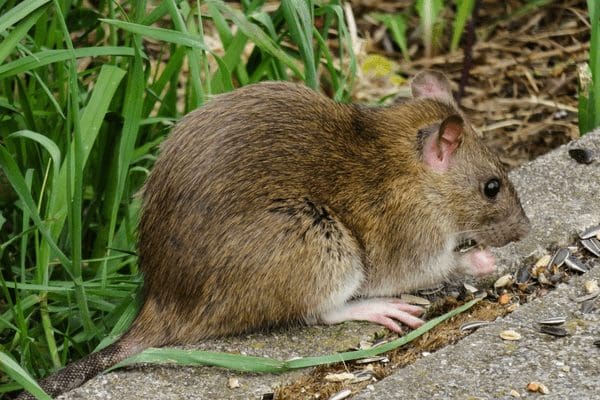
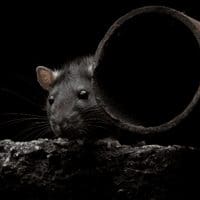
This is the most common species in the UK. It lives mostly outdoors either in burrows or underground in urban sewers. This species is a rapid breeder with four litters a year, the young being sexually mature at 8 – 12 weeks. Signs of activity include well marked travelling routes, gnawing marks and greasy smears left on walls, pipes and around floor joists, against which they habitually brush. Suffering from neophobia, it is notoriously cautious with new objects and food sources.
Approximately 50-70% of rats are believed to carry Leptospirosis, which leads to the potentially fatal Weil’s disease in humans. Both rats and mice carry parasitic and food poisoning organisms such as Salmonella. Disease transmission is via infection of foodstuffs and water supply.
It is estimated that rodents contaminate (via their droppings and urine) up to ten times more food than they consume.
Persistent gnawing by rodents leads to considerable physical damage with woodwork, soft metal pipes and wiring being common targets.
THE BLACK RAT (RATTUS RATTUS)
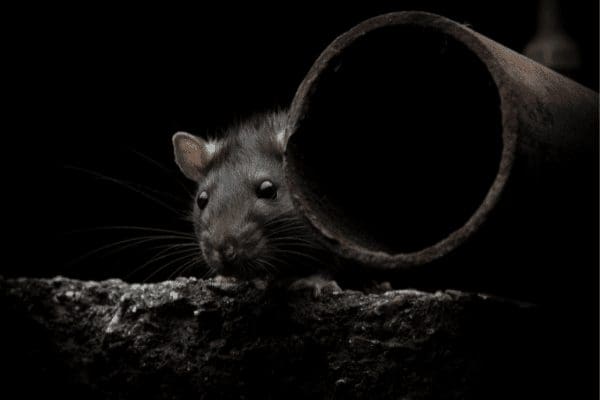
This rat is now rare in the UK and mostly confined to shipping, ports and coastal areas. Also known as the ship rat, it is historically infamous as the carrier of the plague flea. Smaller and more agile than the Brown Rat, it is equally omnivorous with a preference for fruit and spices.
Approximately 50-70% of rats are believed to carry Leptospirosis, which leads to the potentially fatal Weil’s disease in humans. Both rats and mice carry parasitic and food poisoning organisms such as Salmonella. Disease transmission is via infection of foodstuffs and water supply.
It is estimated that rodents contaminate (via their droppings and urine) up to ten times more food than they consume.
Persistent gnawing by rodents leads to considerable physical damage with woodwork, soft metal pipes and wiring being common targets.
BED BUGS
Bedbugs are becoming a significant problem in this country and around the world.
They are easily spread and difficult to treat resulting in a rapid growth in the number of bedbug outbreaks.
The key to beating this problem is to raise awareness of what to look for and to ensure bedbugs are dealt with quickly once discovered.
THE IMPACT OF BEDBUGS
Bedbugs feed on the blood of humans and other mammals.
While it is possible for bedbugs to transmit disease, in this country it is very rare. Instead, the primary concern is the irritation and distress caused by bedbug bites.
Bedbug bites do not hurt. It is the itchiness that results from the body’s reaction to them that causes discomfort.
Treating the bites soothes the irritation, but it can still be very distressing when there are multiple bites as is often the case with bedbugs.
Multiple bites and contact with bedbugs can also lead to an itchy rash or eczema. Consult a pharmacist for advice and treatment if this occurs.
IDENTIFYING BEDBUGS
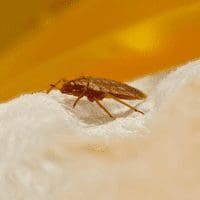
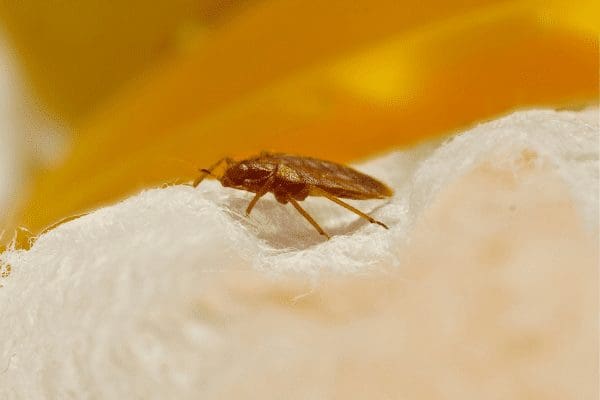
Adult bedbugs are 5mm long. Before feeding they are a flattened oval shape and light brown, but become rounder and darker after feeding.
They come out at night and are attracted to the warmth of our bodies and carbon dioxide in our breath.
They are usually found in bedrooms but hide in cracks and crevices during the day.
The most common shelters for bedbugs are in the seams of mattresses, in crevices in the bed frame, behind furniture surrounding the bed (especially the headboard) or where the wall meets the floor.
A more established infestation is associated with dark or black staining of the mattress from bed bug excreta.
An established infestation will also be associated with an unpleasant odour secreted by bed bugs.
IDENTIFYING BEDBUG BITES
It is difficult to identify bed bugs from their bite because our bodies react very differently to them.
It is more important to look at the overall pattern and timing of bites and other factors to identify whether bites are caused by bed bugs.
BED BUG BITES
Bedbug bites are unlikely to wake the victim. They can occur anywhere on the body but are often close to blood vessels near the skin.
A single bed bug may bite more than once around the same area. However, bites in different parts of the body indicate being bitten by several bed bugs.
BEES
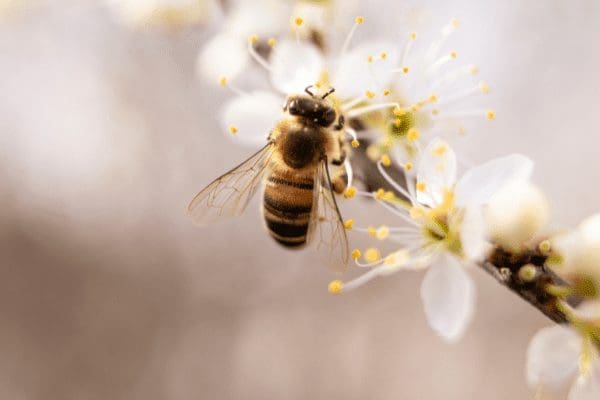
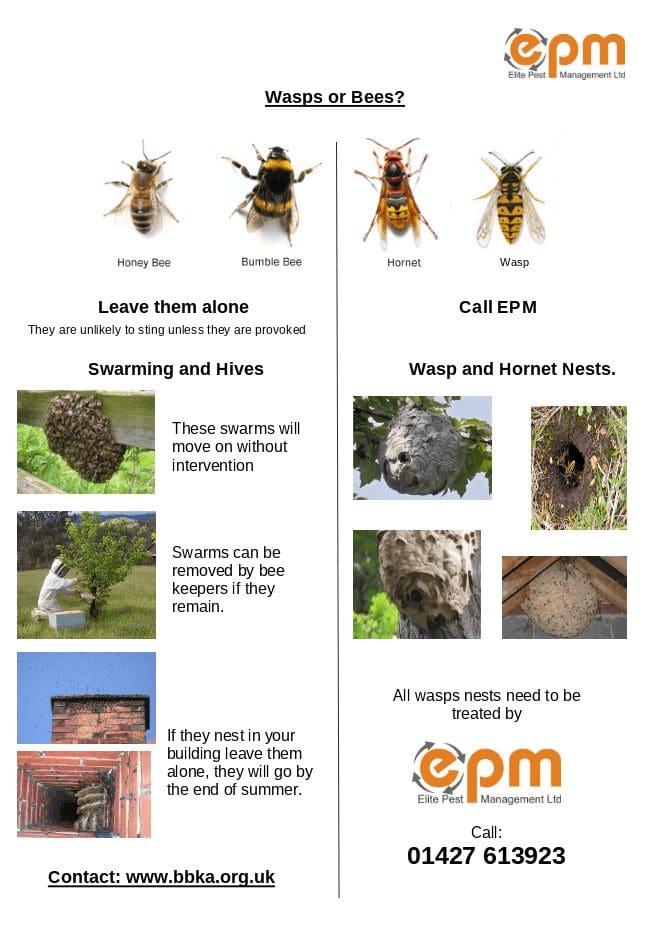
Being stung by a Bee is quite rare as they are much less aggressive than wasps or hornets. Some Bees cannot sting, others such as the Bumble or Solitary Bee only sting if handled roughly. Honey Bees may sting if provoked or they feel you are too close to their hive. If stung, scratch rather than pull the sting out and move away from the hive as quickly as possible.
A sting can be life threatening to one in thirty people who are allergic to stings and may suffer anaphylactic shock.
IDENTIFYING BEES
There are many types of Bees with colonies ranging in size from about 50 up to 50,000 all pollinate flowers and plants. The most commonly seen are Bumble Bees, Honey Bees, Solitary Bees and Mason Bees.
Bumble Bees – Often confused with Honey Bees. The Bumble Bee is larger, furrier and is dark coloured except for golden stripes across the end of their tails. They nest in small wall cavities, holes in the ground, under sheds or in undisturbed compost heaps.
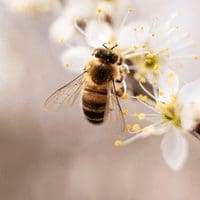
Honey Bees– These are the kind kept by Bee Keepers, although they can live in the wild in hollow trees or in chimneys, wall cavities or roof spaces. They are similar in size to wasps but are furrier and mostly black in colour. It is the Honey Bee that converts nectar into honey and beeswax and is known to swarm. A Honey Bee swarm will arrive in flight and cluster on a tree branch. The noise can be alarming, but the danger is not great if you keep your distance and contact a local bee keeper or Environmental Health Department as they will be able to arrange for the swarm to be relocated.
Solitary Bees – Many of these look similar to Honey Bees and often nest near each other in villages but, as the name implies live alone. Some tunnel in sandy soil, soft mortar in old houses or use domestic air bricks to nest in. They do not swarm and are not aggressive.
HOW TO SAFELY GET RID OF BEES AND RELOCATE THEM
Bees should not be killed and nests should be left undisturbed whenever possible. If a Bees nest represents a very high risk (such as a nest within the home, school, hospital or near those who are allergic to Bee stings), the nest can be removed to a safe area by a professional Bee Keeper.
EPM can destroy a bees nest but only as a last resort and if it is considered a serious threat to humans and only on the advice of a professional bee keeper.
WASPS
MICE (MUS DOMESTICUS)
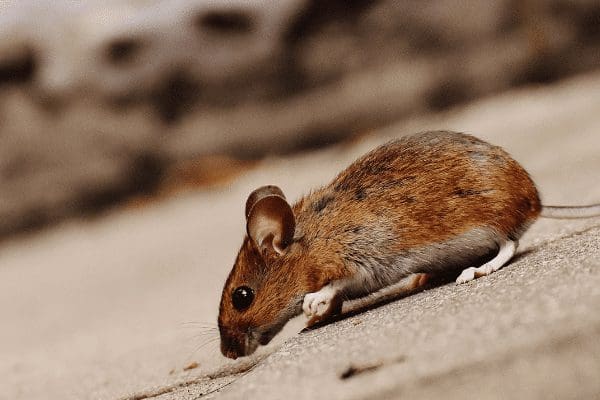
The house mouse first came from Asia. Many centuries ago it spread through Europe. This species came to North America on the ships and in the luggage of the early settlers. This greyish-brown mouse is 13 to 20 cm long, including its tail. Its long tail is nearly hairless, dirty brown, and six to ten cm long. It weighs a mere 18 to 23 g. The house mouse, as its name implies, lives in buildings and places where people live. It also lives outside in fields or pastures where there are good hiding places. It rarely lives in natural or wild places.
The house mouse is well suited to live near and with man. It lives cooperatively in groups or colonies, much like people. Mice take it turns cleaning each other. They share runways, tunnels, and holes through buildings and in the fields. They can scurry up rough walls and pipes since they are light and have feet that grip well. Each mouse builds its own nest of shredded paper, cloth or whatever it can find.
House mice have many enemies besides people who set poisons and traps out for them. All of the meat-eating mammals and birds are their enemies in the fields and meadows.
Mice have many young and re-populate an area quickly. Female mice can have many litters in a field that has a growing crop. Each litter can have from 3 to 16 young. There are usually between five and seven in one litter. House mice have a gestation period of only 18 to 21 days. That means that the young take only 18 to 21 days to develop in their mother’s uterus. They are born blind and hairless but are ready to go out on their own before the next litter comes. Female mice become sexually active shortly after the young are born. Female mice take only a month or two to become sexually mature and have their own young. If there is good food and shelter, they can mature faster. Males take from 7 to 11 weeks to mature. Without predators or animals that eat them, the number of house mice would explode.
Successful control of mice is almost impossible without regular service by a professional pest control company. To eradicate rats and mice and prevent re-infestation requires a close understanding of the pest species, its biology, lifestyle and habits. Elite Pest Management has that expertise and years of practical field experience and use safe and effective measures.
FRUIT FLIES
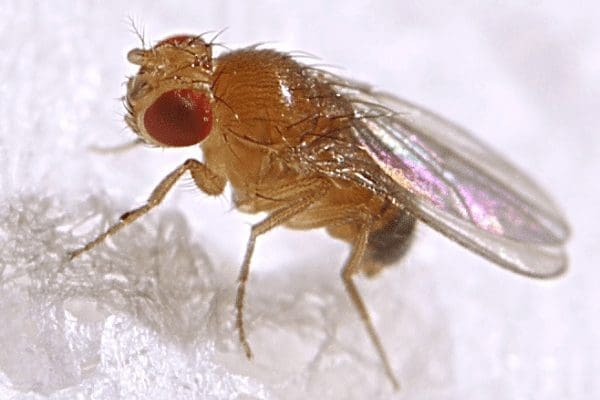
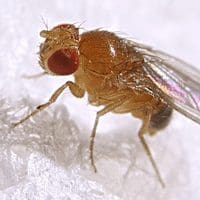
Fruit flies are characterised by a slow hovering flight in which the abdomen hangs down. A family of very small (about 3mm) flies with prominent red eyes,
All fruit flies are associated with rotting fruit and vegetables or fermenting liquids. One species breeds in sour milk, for example, in the residue of forgotten milk bottles.
The fruit fly’s eggs are laid on top of or near rotting fruit or vegetable matter. The larvae emerge from the eggs and feed near the surface of the fermenting material for 5-6 days. The fruit fly larvae then crawl to drier areas of the food source or even out of the food source to pupate. Under ideal conditions, the life cycle of the fruit fly, from egg to adult can be completed in as little as eight days.
This fly is found throughout the world and common near fresh or rotting fruit, damp organic matter and drains.
Because it frequents such unsanitary areas, the fruit fly could potentially carry disease-causing bacteria onto food products.
The effective control of fruit flies includes good hygiene and sanitation, residual insecticides and fly control units.
CLUSTER FLIES
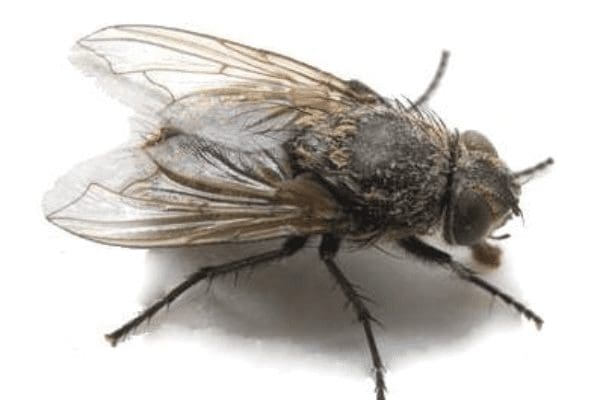
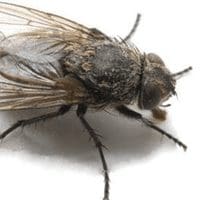
Cluster fly are dark greyish and about 8mm long with yellowish hairs on the back and with overlapping wings.
Females lay their eggs singly in cracks in the soil; the larvae emerge in three days and begin to seek out their food source: earthworms. After burrowing into the earthworm, the larvae feed for about three weeks before pupating. The adult Cluster Fly emerges from its pupa after 12 to 14 days. The adult flies (of which there 3 to 4 generations per year) feed on flowers.
In autumn they congregate in large numbers in upper rooms and roof spaces/lofts of houses to hibernate. The larvae of one species are parasitic upon certain earthworms, so this species is more common in rural areas.
A mass of cluster flies has a characteristic smell. They are sluggish in flight and are a nuisance in the house.
Once cluster flies have found their way into buildings to hibernate they can be difficult to control, due to their fondness for inaccessible space. It is important to seal as many openings as possible to stop flies from entering the building.